
How Much Concrete Do I Need? The Complete Guide (With Free Calculator)
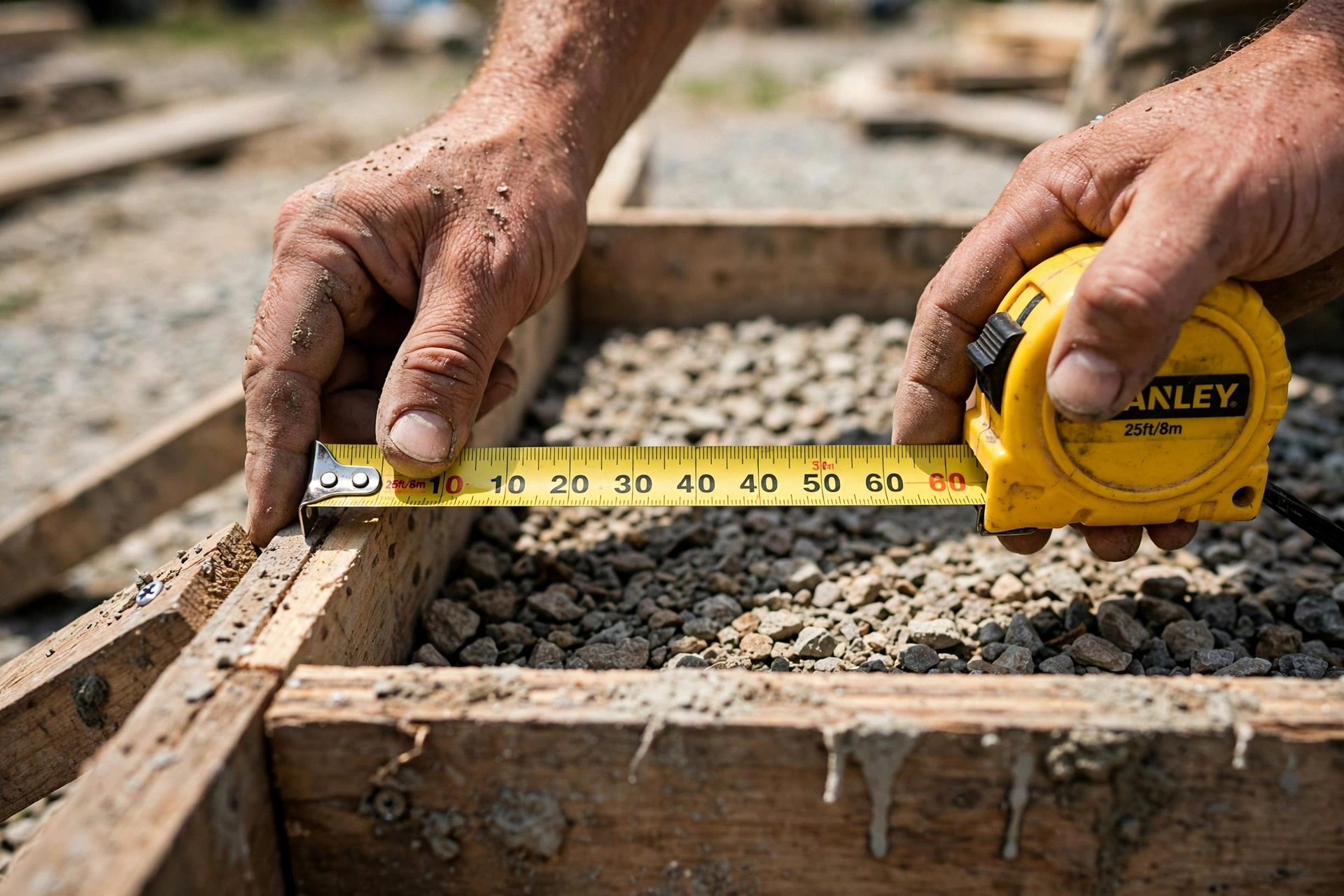
Every concrete project starts the same way. You’re standing in the yard with a tape measure, staring at a patch of dirt, doing rough math in your head and hoping you’re close. And the question running through your mind is the same one every DIYer asks: how much concrete do I need?
Here’s the problem with “close”. You can’t return concrete you don’t use. And you can’t hit pause in the middle of a pour to order more. Get it wrong, and you’re either paying for material that hardens into a very expensive paperweight, or you’re watching your slab develop weak seams because the truck had to make a second trip.
This guide answers exactly how much concrete you need for any project—slabs, footings, walls, and fence posts. You’ll get the contractor’s formula, bag-count charts, real worked examples, and the mistakes that cause most bad estimates. No engineering degree required.
How Much Concrete Do I Need? Start With the Basics
Before you calculate anything, it helps to know how concrete is sold in the US. It comes two ways.
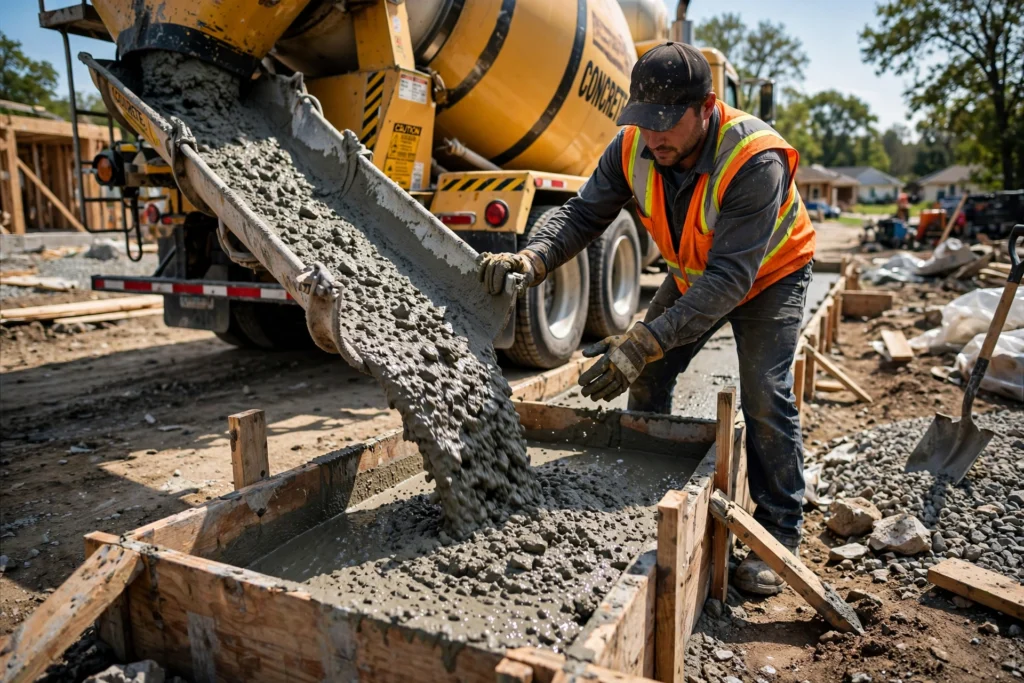
Ready-mix concrete arrives in a mixer truck and is priced by the cubic yard. Picture a box three feet wide, three feet long, and three feet tall. Fill it edge to edge, and you’ve got one cubic yard—27 cubic feet total. Every ready-mix quote in America is based on that box. A full mixer truck hauls around 10 of them, which works out to roughly 450 eighty-pound bags. Keep that image in mind the next time you’re tempted to hand-mix a driveway.
Bagged concrete mix—the Quikrete and Sakrete bags at the home improvement store—comes in 80 lb, 60 lb, and 40 lb sizes. This is the practical choice for small jobs: a walkway, a few footings, and a small pad.
How Much Concrete Do I Need? The Simple Formula
For anything rectangular—a slab, a patio, a sidewalk—the math is dead simple:
(Length × Width × Thickness) ÷ 27 = cubic yards
Measure everything in feet first. That’s the step people mess up, so let’s work out how much concrete you need for a real project.
Say you’re pouring a slab for a 12×16 shed, four inches thick:
- Convert the thickness: 4 inches ÷ 12 = 0.33 feet.
- Multiply: 12 × 16 × 0.33 = 64 cubic feet.
- Divide: 64 ÷ 27 = 2.37 cubic yards.
Round up, add your waste margin (covered below), and you’re ordering about two and a half yards. That’s it. The whole formula fits on an index card.
How Much Concrete Do I Need—Bags or a Ready-Mix Truck?
Here’s a rule that’ll save your back: one cubic yard equals 45 eighty-pound bags. So if your bag count is creeping past 40 or 50, stop pricing bags and call a ready-mix supplier. Hand-mixing 60 bags is a brutal day, and a truck is usually cheaper per yard at that scale anyway.
Bag manufacturers like Quikrete and Sakrete publish their own coverage charts, and the standard yields are
| Bag size | Covers per bag | Bags in one cubic yard |
|---|---|---|
| 80 lb | 0.60 cu ft | 45 |
| 60 lb | 0.45 cu ft | 60 |
| 40 lb | 0.30 cu ft | 90 |
A quick way to sanity-check how many concrete bags you need: Take your total cubic feet and divide by the per-bag coverage. Using 80 lb bags? Divide by 0.6. That shed slab was 64 cubic feet, so 64 ÷ 0.6 = 107 bags, plus waste. Yeah—that’s a truck job.
How Much Concrete Do I Need for a Slab?
If you’re wondering how much concrete you need for a patio, driveway, or shed floor, find your size below. These are standard 4-inch pours, before the waste margin:
| Slab size (4″ thick) | Cubic feet | Cubic yards | 80 lb bags |
|---|---|---|---|
| 10 × 10 ft | 33 | 1.23 | 56 |
| 12 × 12 ft | 48 | 1.78 | 80 |
| 10 × 20 ft | 67 | 2.47 | 112 |
| 16 × 16 ft | 85 | 3.16 | 143 |
| 20 × 20 ft | 133 | 4.94 | 223 |
| 24 × 24 ft | 192 | 7.11 | 320 |
Pouring a driveway at 6 inches instead of 4? Just multiply the cubic yards by 1.5. Thickness scales the math directly.
And how thick should you go in the first place? Four-inch handles patios, walkways, and shed floors fine. Anything with vehicles on it—driveways, garage floors—wants five to six inches.
How Much Concrete Do I Need for Footings and Fence Posts?
Round holes need a different formula:
3.14 × radius × radius × depth = cubic feet
Notice it says “radius”—half the width of the hole. This is where plenty of people go wrong when figuring out how much concrete they need. Plug in the full diameter, and you’ll order four times too much concrete. Ask me how I know people do this. (They do it constantly.)
Example: a 12-inch-wide footing hole, 4 feet deep.
- Radius = 6 inches = 0.5 feet.
- 3.14 × 0.5 × 0.5 × 4 = 3.14 cubic feet.
- That’s 0.12 cubic yards, or 3.14 ÷ 0.6 = 6 eighty-pound bags per footing.
Common footing sizes, per hole:
| Hole size | Cubic feet | 80 lb bags |
|---|---|---|
| 8″ wide × 3 ft deep | 1.05 | 2 |
| 10″ wide × 4 ft deep | 2.18 | 4 |
| 12″ wide × 4 ft deep | 3.14 | 6 |
| 12″ wide × 5 ft deep | 3.93 | 7 |
Setting fence posts? A standard 4×4 post in a 10-inch-wide, 3-foot-deep hole takes about 3 eighty-pound bags. Multiply by your number of posts and you’re done.
How Much Concrete Do I Need for a Wall?
Same rectangular formula, just vertical:
(Length × Height × Thickness in feet) ÷ 27
A garden wall 20 feet long, 4 feet high, and 8 inches thick: 20 × 4 × 0.67 = 53 cubic feet, or 1.98 cubic yards. Add waste and order about 2.25 yards.
The 10% Rule: The Cheapest Insurance You’ll Ever Buy
Knowing how much concrete you need is only half the battle—the other half is ordering a little extra. Every contractor has the same story. The pour that came up half a yard short. The frantic phone call. The truck that couldn’t get back for three hours. And the cold joint—that permanent weak seam—right across the middle of the driveway.
All of it is avoidable for the cost of a little extra concrete. Here’s the rule:
- Add 5% for simple slabs on flat, well-compacted ground with clean forms.
- Add 10% for uneven ground, complicated shapes, deep footings, or your first pour.
When in doubt, go with 10%. Running short mid-pour costs far more than the extra material ever will.
5 Mistakes That Ruin Your Concrete Estimate
1. Doing the math in inches. A 4-inch slab is 0.33 feet, not 4 feet. This one error ruins more estimates than everything else combined.
2. Measuring the plan instead of the hole. If you over-dug your footings, the hole decides how much concrete you need—not the drawing.
3. Skipping the waste margin. See above. Always add 5–10%. Always.
4. Pretending the ground is flat. Low spots in your base eat concrete. If the subgrade is rough, measure the deep spots and lean toward 10%.
5. Hand-mixing a truck-sized job. Sixty bags sounds doable at the store. It stops sounding doable around bag twenty. Match the method to the job size.
FAQs: How Much Concrete Do You Need?
How much concrete do I need for a 10×10 slab?
At the standard 4-inch thickness, a 10×10 slab needs 1.23 cubic yards—about 56 eighty-pound bags before the waste margin.
How much concrete do I need for a 12×12 slab?
A 12×12 slab at 4 inches thick needs 1.78 cubic yards, or about 80 eighty-pound bags. Add 10% and plan for roughly 88 bags.
How many 80 lb bags of concrete are in a yard?
45. A cubic yard holds 27 cubic feet, and one 80 lb bag covers 0.6 cubic feet. Do the division, and you get 45.
What exactly is a cubic yard of concrete?
It’s 27 cubic feet of concrete: imagine a box three feet on every side, filled solid. That’s the unit every US supplier prices by.
How much does a cubic yard of concrete weigh?
Roughly 4,000 pounds, or two tonnes. Worth remembering when you’re thinking about what sits underneath it—and when you’re unloading bags.
How thick should my concrete slab be?
Four inches for patios, walkways, and sheds. Five to six inches for driveways, garage floors, or anything carrying vehicles.
Can I pour a slab in sections?
You can, but concrete poured against concrete that’s already setting forms a cold joint—a built-in weak spot where cracks love to start. One continuous pour is always better for slabs.
How long do I have once the ready-mix truck arrives?
About 90 minutes from batching before the concrete starts setting. Have your crew, tools, and forms ready before the truck shows up, not after.
How many bags of concrete per fence post?
Plan on 2–3 eighty-pound bags per post for a typical 4×4 set in a 10-inch-wide, 3-foot-deep hole.
How do I calculate concrete for round footings?
Multiply 3.14 × radius × radius × depth (all in feet) to get cubic feet, then divide by 27 for cubic yards. Remember: radius, not diameter.
The Short Version
Measure in feet. Multiply length × width × thickness. Divide by 27. Add 10% so you don’t run short. Bags for small jobs, a truck for anything over about a yard. Now you know how to answer “how much concrete do I need” for any project—that’s the whole game.
Want to skip the arithmetic? Punch your measurements into our free concrete volume calculator and calculate how much concrete you need in seconds. No sign-up, no fuss. (Replace this link with your concrete calculator page URL before publishing.)
Need another calculation? Browse all our free online calculators—from loan payments to unit conversions.